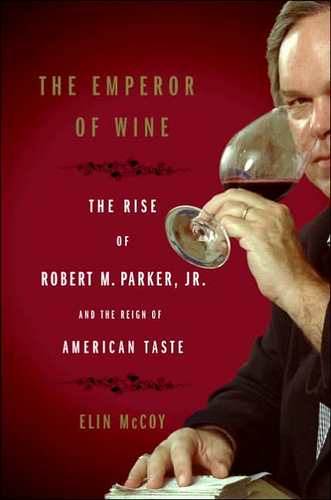
 Over this past weekend, I wrapped up Robert M. Parker Jr.'s biography,The Emperor of Wine by Elin McCoy. It turned out to be a very entertaining read. For those unfamiliar with Parker, he's the guy who decides if a wine is good or bad. Not you, not your friend, not even the chef at your favorite restaurant. Parker is the be all and end all of wine. At least, that's what his followers would have you believe. This book was a trip back in time to the earlier days of wine tasting. When tasting notes were just that, notes. No numbers involved, strictly words. A handful of people tried scoring wines with a 1 to 20 point scale, but it wasn't very effective at conveying a wine's worth. Parker knew the numbers could be useful if they were presented appropiately, especially in America. He knew we all craved things that were perfect. And what score always meant perfection on that 4th grade spelling test, 100. Parker adopted a hundred point scale that became the standard in today's wine industry. Yes, Parker has an amazing ability to deconstruct a wine's scent and flavors. Yes, the wines he scores highly tend to be good wines. But are you seriously telling me, that if Parker gives it higher than 90 points I am going to like it? Or anyone else will for that fact. Parker understood that Americans crave numbers. We eat them up on CNN, The Today Show, and especially ESPN. Now people started eating up high scoring wines. If Parker gave a wine 92 points in the latest issue of his Wine Advocate, that wine was like Tickle Me Elmo at Christmas. Gone. I have always advocated that people not read to much into this numbers game. Yes, its nice to brag about a high scoring wine that you own. And I even subscribe to Wine Spectator, I like to read the articles. But please use the ratings as a guideline. You need to try and find what wines you like with your palate, not Parker's. And what better place to learn about what you like then our inaugural Wine from A to Zin Night on November 3rd. Flyers will be appearing soon! Till next time..."Where there is no wine there is no love."--Greek Proverb
Tuesday, September 26, 2006
Playing the Numbers Game
Over this past weekend, I wrapped up Robert M. Parker Jr.'s biography,The Emperor of Wine by Elin McCoy. It turned out to be a very entertaining read. For those unfamiliar with Parker, he's the guy who decides if a wine is good or bad. Not you, not your friend, not even the chef at your favorite restaurant. Parker is the be all and end all of wine. At least, that's what his followers would have you believe. This book was a trip back in time to the earlier days of wine tasting. When tasting notes were just that, notes. No numbers involved, strictly words. A handful of people tried scoring wines with a 1 to 20 point scale, but it wasn't very effective at conveying a wine's worth. Parker knew the numbers could be useful if they were presented appropiately, especially in America. He knew we all craved things that were perfect. And what score always meant perfection on that 4th grade spelling test, 100. Parker adopted a hundred point scale that became the standard in today's wine industry. Yes, Parker has an amazing ability to deconstruct a wine's scent and flavors. Yes, the wines he scores highly tend to be good wines. But are you seriously telling me, that if Parker gives it higher than 90 points I am going to like it? Or anyone else will for that fact. Parker understood that Americans crave numbers. We eat them up on CNN, The Today Show, and especially ESPN. Now people started eating up high scoring wines. If Parker gave a wine 92 points in the latest issue of his Wine Advocate, that wine was like Tickle Me Elmo at Christmas. Gone. I have always advocated that people not read to much into this numbers game. Yes, its nice to brag about a high scoring wine that you own. And I even subscribe to Wine Spectator, I like to read the articles. But please use the ratings as a guideline. You need to try and find what wines you like with your palate, not Parker's. And what better place to learn about what you like then our inaugural Wine from A to Zin Night on November 3rd. Flyers will be appearing soon! Till next time..."Where there is no wine there is no love."--Greek Proverb

Thursday, September 21, 2006
Open Season
 It's that time of year. The air gets a little bit more crisp. The leaves lose their luster. And a stiff breeze swiftly blows through the trees. That's right, deer hunting season! Nah, just playing with you. It's wine season. Of course summer is a nice time to enjoy some chilled Riesling, but for me, wine consumption really picks up in the fall. We started of the season last night at The Up River Cafe. Where else would I be on Wednesday? Katie and I dined with our good friend Phil. We started out with a solid bottle of 2005 St. Supery Sauvignon Blanc. This wine gets me every time. From the intense grapefruit aroma, to the crisp finish, it is truly delightful. For an appetizer we had the Asian Fried Calamari, my all time favorite. Speaking of which, Dad, how are those roasted red peppers? For entrees, Katie had the Grilled Atlantic Salmon and Phil had the special, a Center Cut Pork Chop. I indulged on the 10 oz. Coulette Steak. This cut had all the flavor of a filet but with a different texture. It didn't really melt in my mouth like a filet. We paired these dishes with a bottle of 2001 Swanson "Alexis" from Oakville. This wine was made to impress. Unlike traditional blended wines that echo Bordeaux with a majority of Cabernet Sauvignon and Merlot, or the Rhone Valley with Syrah and Grenache, the good folks at Swanson decided to mix it up a bit. They started with a majority of Cabernet, but then blended it with Syrah. This would be a travesty to traditional wine drinkers, much like using a screwtop. They then put in a bit of Cab Franc and Merlot to finish the blend. Simply put, a fantastic wine. It was silky smooth like a well done Rhone wine, but still had the cedar and blackberry flavors that are consistent with a Cabernet. Katie felt it was drinkable now and might only benefit from another year in the bottle, but I believe you could still age it another five years and it would only improve. That of course led to a heated debate that Phil feeling like none other than Dr. Phil during a heavy counseling session. That's all for today. I am off to Martha's Vineyard this weekend, but will be posting on glassware early next week. Till next time..."I wanna say something. I'm gonna put it out there; if you like it, you can take it, if you don't, send it right back."--Ron Burgundy, dedicated to Phil
P.S. Mark your calendars-Friday November 3rd-Inaugural Wine from A to Zin night in Ashaway, RI. More details to follow!
Saturday, September 16, 2006
Too Long
 It's been way to long since my last post. I need to get better at posting less words but more often. So here's a quick run down of what's new in my world of wine. I checked stock on my cellar the other day. It's dwindled down to around 45 bottles or so. I know, I know you're all thinking, "45 bottles is dwindling, what a wine snob!" I prefer you use term wine geek from now on. I am halfway through a nice biography of Robert Parker, Jr. and his successful Wine Advocate magazine. It's providing a lot of insight into the world of ratings and points in the wine industry. My dear friend Mike is off seeing the world of wine first hand for the first time. Thanks to an unbelievable scholarship, he is currently in California, visiting Napa, Sonoma, and Santa Barbara, before jet-setting to Italy and France. Needless to say, my jealousy boils in my stomach like a well aged scotch. Nonetheless, I am extremely proud of him. Other than that, the wine consumption front has been slow, hopefully it will pick up into the fall and winter months, I feel they are the best for drinking, and more importantly, admiring fine wine. Next post, should be the conclusion of the Parker book, or some quick notes on what stock is left in my cellar. Till next time..."Wine is one thing; drunkenness another."--Latin Proverb
Sunday, August 13, 2006
Quick Book Review
 Over the past week I finished Don and Petie Kladstrup's Wine and War. This book came highly recommended by many people we talked with in Oregon on the last wine excursion. The book itself sis not disappoint. It's a collection tales that tell of how the Nazi's attempted to plunder France's greatest asset, her wine. Things get interesting when the French go to great lengths to protect what they felt the Germans wouldn't appreciate. Hiding wine consisted of building new walls to block off hidden cellars, weighting cases to the bottom of the pond, or burying bottles in the garden. There was also the sabotage of shipments bound for Berlin and the Resistance using Champagne's underground maze of cellars as a impromptu headquarters. The book mainly follows individual story lines and how each one had varying effects on the war and the wine industry. The authors also examine how each major region was affected how the vineyards dealt with the occupation and eventual liberation. As a wine lover, as well as history lover, this book blended two of my favorites into an enthralling tale of determination, intelligence and heroism.
Saturday, August 05, 2006
Wine at Dinner, Wine at Home
 Reporting live from the new Dell XPS 400 at the Felty home. For starters...big thank you to Mike, not only did we have a great time at his graduation party, but boy did he treat us right at dinner last week. Last Friday we trekked up to Providence's Napa Valley Grille for peaceful dinner in order to properly celebrate Katie's promotion, and low and behold, mike was our waiter. We started out with a glass of Ferrari-Carano Fume Blanc and a glass of Pine Ridge Chenin-Blanc-Viognier. We had tasted the Pine Ridge earlier in the week at Go Fish, and Napa Valley Grille clearly takes better care of their wine, as the fruit flavors were much more forward and noticeable on the nose. The Fume was as good as always, one of my all-time favorites. For appetizer, Katie had a salad with Goat Cheese Croutons, and I had Tuna Tartare. The raw Yellowfin Tuna with wasabi cream was amazing. It wasn't too long before Mike arrived with a delectable bottle of red. A 1997 Clos Du Val Stag's Leap Cabernet! Ahhhh! Nothing touches me like a '97 single AVA Cabernet from Napa, they set my heart on fire! This one did not disappoint. I know a good Cab when it smells like Nana's basement with the cedar walls. For those of you who knew Nana and Poppy's house you know what I am talking about. For other's, it was like taking a deep waff of a cedar chest. That heavy cedar is what made me fall in love with California Cabs. The Clos Du Val followed with flavors of black currant and an earthiness across the finish which last for well over half a minute. It was an excellent wine at an unbelievable price thanks to Mike. For entrees, I had the Filet Mignon with potatoes and mushrooms, while Katie had a delicious Salmon dish with Palenta. Of course, after desert the night led to more libations, mostly tasty ales at various location across Providence. Once again thank you to Mike, and Demonica, for allowing us a fun evening and a place to rest our heads in the wee hours of the morning.
Tonight my wife and I decided to have short celebration before I ship off to Martha's Vineyard for the week. For starters, big surprise here, a bottle of the 2004 Ferrari-Carano Fume Blanc. As delicious as always. Next up was the 2001 Pine Ridge Rutherford Cabernet Sauvignon. All I can say is WOW! My kind of Cab, not to heavy but still filling. I tasted loads of creamy milk chocolate, a sign of California Merlot, but something that clearly developed in the Pine Ridge over its four years in the bottle. I couldn't get enough of this wine and must search out another bottle. In other news, Katie and I are in the preliminary planning stage of our monthly wine tasting party. The plan is to get together one Friday each month and taste some wine for the possibility of purchase by the case to save a dollar or two a bottle. Leave a comment if your interested. Till next time..."I haven't been so happy since we crushed Poland!"--Franz Liebkind, The Producers (2005)
Sunday, July 23, 2006
Quick Notes
Some quick notes on a few wines. Last night we attended a party put on by one of Katie's co-workers. We brought along a bottle of 2001 Penfold's Bin 128 Coonwarra Shiraz. What a great wine! I used to have a bottle that I paid $22 for, I found it at the store yesterday for $17.99. It's such a bold wine but not overpowering. Then came a bevy of Syrahs. First up wasn't actually a Syrah but Bogle's Petite Sirah, a totally different animal. This wine was somewhat heavy but so smooth on the palate. Next up was a 2003 Cline California Syrah. This was nice, it was velvet like on the tongue and I especially enjoyed the mocha flavors. Finally was a R.H. Phillips Syrah EXP. I didn't pick up the vintage, but it didn't matter, I loved it. It was light bodied and easy drinking with a lovely herbal tone. In the end, it was a good night, four wines, four good reviews. Till next time..."To take wine into our mouths is to savor a droplet of the river of human history."--Clifton Fadiman
Wednesday, July 12, 2006
Wine Shop Review
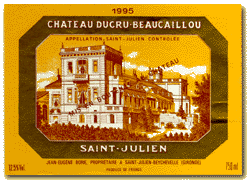 Last night I checked out Thames River Wine and Spirits in New London, CT. I have heard many nice things about this store so with my wife and in-laws we headed over. The most pleasing part of the visit was the setting. The majority of their sales floor is on the lower level in an actual cellar. The ceilings are almost two stories high, and there is that exciting chill in the air of a wine cellar or cave. They are the first store I have visited that makes use of vintage view racks. These racks display bottle horizontally from left to right on the wall, as opposed to traditional lay down bins or stands. It adds an amazing dramatic flair to the room, not to mention the visible stone foundation. They also use traditional displays throughout the cellar. As for their selection, I was impressed, but not floored. I expected more high end French and American wines. Don't get me wrong, they had some expensive wines, like a 1996 Chateau Haut-Brion and some DRC from Burgundy. However, I can find better selection in the $100 and up range in Westerly. There selection seemed to focus on more unique wines that can be hard to find, but not necessarily extremely expensive, such as Single-Vineyard Calera Pinot Noirs, or mid-level French wines. So what did I walk out with you ask? I selected a bottle of 2001 Chateau Ducru-Beaucaillou. This is a second growth from St. Julien in Bordeaux, but it is sometimes referred to as a "Super-Second" because it can turn out wine as good as the first-growths. This is by far the best bottle of French wine I have been able to acquire for my cellar. Katie, my magnificent wife, selected a bottle of 2004 Two Hand's McClaren Vale Lily's Garden Shiraz. Two Hands is one of the premier wineries in Australia today. Needless to say I am ecstatic about these two new editions to my cellar. I hope to swing by Thames River on a Friday for their free wine tasting. I would recommend shopping there for a new experience, but I still think I'll be strolling into Westerly for my typical purchases. Till next time..."Wine is like music-you may not know what is good, but you know what you like!"--Justin Meyer, American Winemaker
Thursday, June 22, 2006
A bottle of white, a bottle of red
 Last night we trekked over to Up River Cafe for some more half-price wine before the summer season. The food as excellent as always. Katie had the Filet, my mom had the Baby Chicken, my dad had the Bistro Burger, and I had the Striped Bass special. The highlight of the evening had to be my dad trying a roasted red pepper from his Calamari after the waitress warned him not to eat them. His reaction was priceless, "I think it burned off a piece of skin in my mouth." On to the wine. We started with a bottle of Cakebread Cellars 2005 Sauvignon Blanc. I was impressed, as were the other diners. My mom noticed how she couldn't really pick up the burn from the alcohol. This really stuck with me because the wine had a %14.1 alcohol content. This is becoming the new trend in wine. Harvesting the super-ripe grapes and getting great wines but with high alcohol. Typical wines used to hover around %12-%13. The wine also carried great aromas and flavors of grape fruit with a nice mineral finish. For a red we tried the 2003 Caymus Napa Valley Cabernet. What a splendid wine. This was my first experience with Caymus Vineyards, and I wasn't let down. The wine was smooth and seductive with a glorious finish that left berry flavors dancing on my tongue. I thought it went very well with the Chocolate Plate Dessert we also indulged in. It was a young wine that had a lot of power and might prove to be even more fascinating as it ages. In the end, the wine, food, but most especially, the company, made it a wonderful night. As I head off to Martha's Vineyard for the next days I'll leave you with this..."Wine is the sort of alcoholic beverage that does not destroy but enriches life; does not distort but clarifies perspective; does not seduce except in a way worth humanly being seduced."--Bill St. John
Wednesday, June 14, 2006
Oregon Pinot Noir: My new love
 The other night at my parent's house, I uncorked a 1999 Willamette Valley Vineyards Karina Vineyard Pinot Noir. This single vineyard selection was by far the rarest bottle I have ever tasted. Only 112 cases if this wine were made, or about 1300 bottles. The only other wine I own close to being that rare is our 2000 Beaulieu Vineyards Rutherford Clone 4 Cabernet Sauvignon, which produced less than 300 cases. The Pinot was excellent. I have really grown fond of the earth and mineral flavors of the Oregon Pinot Noirs. Wine Spectator mentions flavors of "peppery currant," and I'd have to agree. The slight spiciness meshed well with the fruit flavors. I was very impressed by this effort from a winery that is producing mass quantities of their regular offerings. We also had a bottle of Penfold's South Eastern Australia Semillion/Chardonnay. My mother and I both found it to be an great value. It's an easy drinking white that seems meant for summer. I would have to give it my "Porch Wine" recommendation!
Saturday, June 10, 2006
A Bordeaux Book Review
 I recently finished reading Noble Rot: A Bordeaux Wine Revolution by William Echikson. This non-fiction volume focuses on the sweeping changes that have occurred over the past two decades in the world's most famous wine making region. First some background info on Bordeaux and French Wine.
Wine from "new world" regions (i.e. America, New Zealand, Chile) is labeled and sold with the varietal right on the label. It allows the buyer to easily locate what they like or don't, such as a cabernet versus a merlot. French, and other "old world" wines, are labeled and sold by their region. You'll be hard pressed to find a traditional French vinter who puts the names of grapes right on his label. So when we talk about red wines from Bordeaux we are focusing on two major grapes, Cabernet Sauvignon and Merlot, and some minor ones used for blending, Cabernet Franc, Petite Verdot, and Malbec. A Bordeaux will be crafted from some assemblance of these grapes that are blended together. For white wines, you'll find mostly Sauvignon Blanc and Semillion in your bottle with some vinters using Muscadelle to add fruit flavors. In America today, you'll find mostly strict varietal wines, such as a Cabernet Sauvignon with a minor percentage of Merlot added to soften the wine. But there are "Bordeaux-style Blends" that are commonly referred to as Meritages in America. Joseph Phelps Insignia is perhaps the flagship of this American take on the French classic.
Also in Bordeaux, the wines are classified into a tiered system to designate quality. In 1855 Paris was hosting the world's fair and the French government wanted a way to classify wines to point visitors to their highest quality wine in the simplest manner. The winemaker's union in Bordeaux released their 1855 classification based on five tiered system for the wines from the Mèdoc. The "first-growths" were the wines with the highest regard, and price. One first growth, Chateau Haut-Brion, is from Graves but was added due to its high-esteem, and another, Chateau Mouton-Rothschild, petitionedd to move up from second to first-growth and was officiallyy classified as such in 1973. This classification however, did not encompass all of Bordeaux. It left the "right bank" wines from St. Emillion off the list. Many terrific, first-growth quality wines are produced here, so in 1985 they devised their own classification.
At last onto the book review. Echikson wove his tale of the ever-changing Bordeaux landscape around three primary types of vinters in the region. The first is a classic family-owned Chateau, struggling to survive with France's antiquated political and judicial systems. The second depicts what are known as garage wines, upstart wineries with small plots of land and harsh harvest techniques, that create outstanding wines that are created and aged out of a garage essentially. And third, the new money in Bordeaux; outsiders coming in with financial backing to purchase, renovate, and rejuvenate chateaux that may have lost their luster. He also includes commentary on how all these types of wineries are affected by celebrity wine makers like Michael Rolland, who will help anyone create a high-scoring wine for the right price, and Robert Parker, the Maryland lawyer who changed Bordeaux forever with his analysis of the 1982 vintage.
Chateaut D'Yquem creates what is perhaps the finest of all French wines. It is a sweet wine from Sauternes that comes from the Sauvignon Blanc and Semillion grapes. The grapes are only harvested after they have succumbed to Botryis, also referred to as Noble Rot. The grapes that are harvested look shriveled and brown from the fungus, but this concentrates the fruit, and the resulting wine can best be described as sweet nectar of the gods. D'Yquem fought through nasty family problems as a group of family members banded to together to try and overtake Alexandre de Lur-Saluces, who they felt was mismanaging the family treasure. They weren't able to take control, but decided instead to sell off to an investor who could afford to take care of the Chateau and continue to produce an outstanding wine. They eventually sold to LVMH (Louis Vuitton Moet Hennessy), and its owner Bernard Arnault. However, at the last moment Lur-Saluces also offered Arnault his share of ownership at a premium in return for staying on to operate D'Yquem and having his family barred from the board of director's and the estate. Arnault agreed and Lur-Saluces last second maneuver turned certain defeat to his family into sweet revenge, perhaps even sweeter than his wine.
The garage wines have become quite the phenomenan in Bordeaux. The typical garage winemaker is local villager who has a small plot of vineyard that he used to simply harvest and sell the grapes off in bulk. But by drastically reducing yields and harvesting heavily concentrated and ultra-ripe grapes that are then fermented and aged in %100 new oak barrels, they can create a wine that will eventually sell for over a hundred dollars a bottle. All they need to get started is a merchant willing to take a chance and an opportunity to have Robert Parker taste their wine. If Parker comes in and gives one of the garage wines a good score, it will sell its futures in a matter of hours at double the typical cost. Some call it the "Parkerization" of the wine industry. Parker gives a wine a good score and consumers assume it must be a great wine. But remember what I always say, wine is about what you like and what you enjoy, not Robert Parker. His scores and the ones from Wine Spectator, can be a good guide, but your palate needs to be the final judge.
The final plot in the book focuses on the new money. Mainly a man named Yves Vatelot who searches out properties that have fallen into disarray and are making wine unworthy of their classified growth. His most recent venture is Chateau Lascombes. Lascombes is a second-growth that had been slowly declining in quality. Parker felt a re-evaluation of Bordeaux would make it a fifth-growth. Vatelot, backed by investors, cleaned up the vineyards, instituted the harsh harvesting techniques used by the new-age wineries in Bordeaux, built a new winery and cellar, and crossed his fingers for good weather. After a few vintages, Lascombes was on the rebound and appearing to be a wise investment. In the future, I'll let you know how Vatelot is doing, I purchased a bottle of Chateau Lascombes yesterday.
I felt William Echikson did a superb job with his novel. Noble Rot came across as both educational and historical, providing plenty of details about the past, and terrific insights into what is happening in the present. I highly recommend it for anyone with an interest in wine who wants to quickly increase their knowledge of the French wine industry. Where will Bordeaux go from here? After four years of average wines, 2005 appears to be not only the greatest vintage
since 2000, but perhaps even better than the banner year of 1982. Some experts even feel it could turn out to be the greatest vintage ever! Time will tell. Till next time..."Yves, you may be a pain in the ass to work with, but you sure make one helluva wine."--Jeffrey Davies, American turned Bordeaux Merchant
Subscribe to:
Posts (Atom)
